
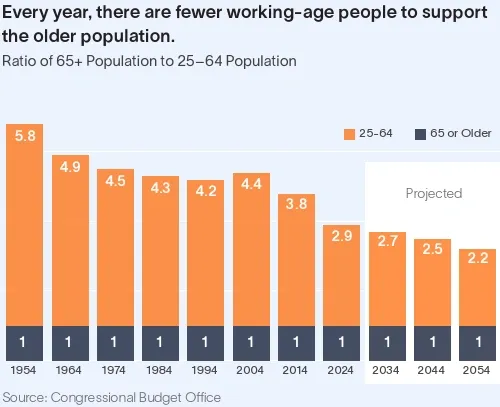
As the year winds down and leaders prepare their budgets, goals, and hiring plans for 2025, workforce planning should be at the top of the agenda. The labor market is shifting beneath our feet—not because of short-term trends, but because of deep demographic and structural changes that will define the next decade. According to Lightcast’s The Rising Storm report, employers are facing a long-term labor shortage fueled by mass retirements, slowing population growth, and widening skill mismatches. These forces are converging to create what economists are calling a “demographic drought.”
To stay competitive, employers must act now—using Q4 to analyze, forecast, and strengthen their workforce strategies for a tighter, more complex talent landscape ahead.
What Employers Should Be Thinking About
1. Mass Retirements and Demographic Shifts
The “Silver Tsunami” is no longer a forecast—it’s happening. Since 2021, roughly five million workers have exited the U.S. labor force, and nearly 80% were over age 55. The average retirement age has fallen to around 61, accelerating talent gaps faster than anticipated. Lightcast projects population growth to outpace labor-force growth by roughly 8:1 by 2032, with participation rates expected to drop to around 60.4%.
The takeaway: Employers can no longer assume a steady or growing talent pool. Future hiring success will depend on proactive planning and creative sourcing strategies.
2. A Widening Mismatch Between People and Jobs
The U.S.-born workforce is shrinking, while immigrant participation drives most of the growth. Prime-age male participation (ages 25–54) has fallen from 94% in 1980 to about 89% today, while many in-demand roles—in healthcare, trades, logistics, and service—do not require a four-year degree. Yet higher-education pipelines still dominate.
The takeaway: Hiring based on traditional credentials alone will limit access to talent. Employers must rethink what “qualified” means, emphasizing trainability, skill adjacency, and real-world potential.
3. The Limits of Automation
While automation and AI promise efficiency gains, Lightcast emphasizes they are not an immediate fix for the sectors most affected by shortages—healthcare, manufacturing, construction, and service roles. These are deeply human, hands-on jobs.
The takeaway: Employers should invest in technology that supports workers, not replaces them—such as workflow tools, scheduling optimization, and accessible learning platforms.
4. Industry-Specific Vulnerabilities
The labor-market “storm” will not hit evenly. Industries with high physical-presence requirements and aging workforces—like manufacturing, healthcare, and hospitality—are already seeing the outer bands.
The takeaway: Workforce planning must be industry-specific. Companies in vulnerable sectors should begin modeling labor shortfalls and building partnerships to fill pipelines early.
What Employers Should Be Doing Now
1. Revisit Talent-Supply Assumptions
Audit your organization’s demographics to identify who’s likely to retire or exit in the next three to five years. Replace outdated assumptions of a plentiful labor pool with strategies for a constrained one. Broaden your reach to include immigrants, retirees seeking part-time work, and under-represented groups.
Re-evaluate job qualifications—if a role has historically required a degree, ask whether that requirement still aligns with business needs or unnecessarily limits your pool.
2. Upskill, Reskill, and Redesign Roles
Map critical skills and determine where gaps will emerge. Develop internal training, mentorship, and career-pathing programs that allow employees to move into hard-to-fill roles. Consider flexible scheduling, hybrid arrangements, or job sharing to attract talent from groups balancing work and caregiving responsibilities.
3. Elevate Workforce Planning to a Strategic Function
Lightcast urges leaders to treat workforce risk as a board-level issue, not just an HR concern. Integrate workforce data into financial forecasting, scenario planning, and technology investment. Model “what-if” scenarios—such as slower automation adoption or faster retirement waves—to understand exposure and prepare contingency plans.
4. Diversify Talent Strategies
Widen recruitment channels to reach overlooked populations, and double down on retention. In a shrinking labor market, keeping the people you have will deliver a higher ROI than constant replacement.
Review compensation, benefits, career paths, and culture. Make your mission and values visible—employees increasingly choose employers aligned with purpose and flexibility.
5. Plan Beyond Next Quarter
Lightcast warns that, without action, the U.S. may face a shortfall of up to six million workers by 2032. That reality calls for long-range workforce modeling—not just annual headcount budgets.
Partner with educational institutions, workforce boards, and community programs to co-create pipelines for critical roles. Monitor policy shifts in immigration, childcare, and workforce participation incentives, and adjust talent strategies accordingly.
The message is unmistakable: today’s tight labor market isn’t a temporary squeeze—it’s the beginning of a structural shift that will redefine how organizations attract, develop, and retain talent.
The employers who thrive in the decade ahead will be those who start planning now:
- Analyze your workforce demographics and retirements.
- Invest in skills, flexibility, and internal mobility.
- Diversify your hiring channels and reimagine job design.
- Make workforce planning a strategic, data-driven discipline.
Think of this moment as your weather forecast—the clouds are gathering, but there’s time to prepare. The sooner you start, the stronger and more resilient your organization will be when the storm makes landfall.
At Franklin Professional Associates, we partner with employers across Massachusetts and New England to build workforce strategies that anticipate change—rather than react to it. From compensation analysis and precision recruiting to workforce planning and retention consulting, we help you strengthen your team for the long term.
Let’s start a conversation about your 2026 workforce strategy.
Contact us today.

