

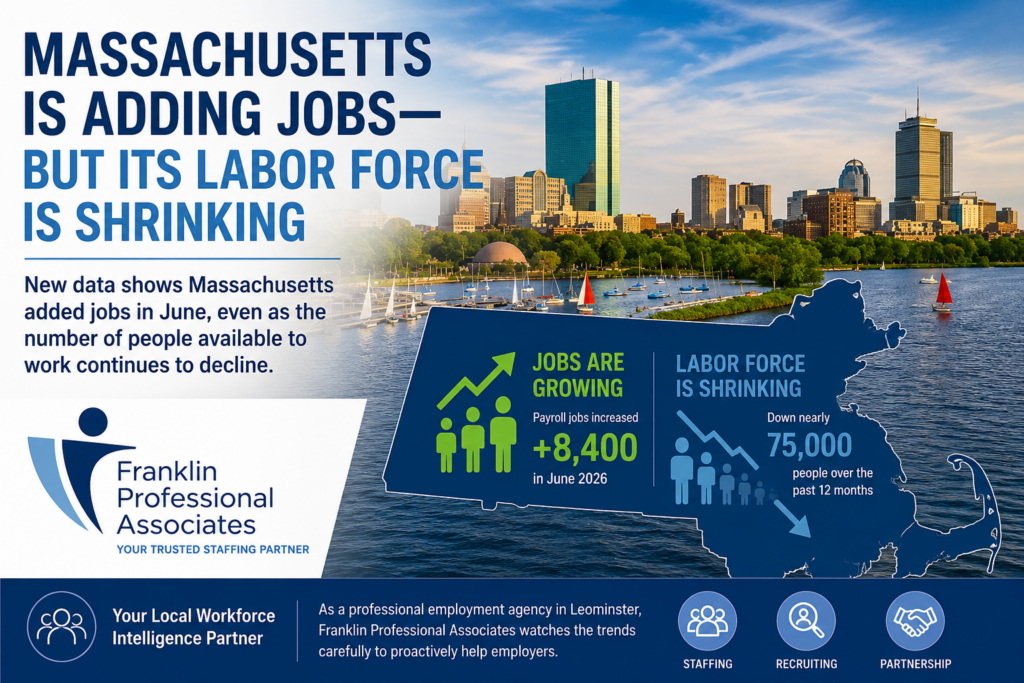
Massachusetts employers are facing an interesting contradiction: businesses continue to add jobs, but the number of people available to fill those jobs is getting smaller. As a professional employment agency in Leominster, Franklin Professional Associates watches labor market trends carefully so we can proactively help employers understand changes in the workforce, anticipate hiring challenges, and make informed decisions about attracting and retaining talent. One trend we’re watching particularly closely right now is the shrinking Massachusetts labor force.
At first glance, Massachusetts’ latest employment numbers look relatively stable. The unemployment rate declined to 4.4% in June, and employers added approximately 8,400 payroll jobs during the month. But beneath those headline numbers is a workforce trend Massachusetts employers should be paying close attention to:
The number of people participating in the Massachusetts labor force is shrinking.
In June 2025, approximately 3.95 million Massachusetts residents were either employed or actively looking for work. By June 2026, that number had fallen to approximately 3.87 million. That’s a decline of nearly 75,000 workers in just 12 months. And the contraction has accelerated in 2026. Since January alone, Massachusetts’ labor force has declined by approximately 53,000 people.
Where Are the Workers Going?
Massachusetts officials have identified retirement as one of the primary factors contributing to declining labor-force participation. That matters because a worker retiring is very different from a worker becoming unemployed. When someone loses a job but continues looking for work, that individual remains part of the labor force and is potentially available to another employer. When someone retires or otherwise leaves the labor force altogether, that person is removed from the available talent pool.
For employers, that distinction is important. A cooling labor market may reduce some of the intense competition for talent we experienced several years ago, but it does not necessarily mean Massachusetts is developing a large surplus of available workers. In fact, the opposite may be happening in certain occupations.
Employers Are Still Adding Jobs
What’s particularly interesting about the latest data is that Massachusetts employers added jobs in June even as the state’s labor force continued to contract. Several industries important to the Massachusetts economy continue to show year-over-year employment growth.
- Construction employment is up approximately 2.5% from a year ago.
- Education and Health Services, the state’s largest employment sector, is up approximately 1.5%.
- Manufacturing employment is up approximately 1.0%.
- And Professional and Business Services moved back into positive territory, increasing approximately 0.3% year over year.
Not every sector is growing. Information, Financial Activities, Trade/Transportation/Utilities and Other Services remain below their employment levels from a year ago. But overall Massachusetts payroll employment is approximately 0.5% higher than it was one year ago. That creates an interesting dynamic: employers are continuing to add positions while the number of people available to participate in the workforce is moving in the opposite direction.
What Does This Mean for Massachusetts Employers?
The unemployment rate alone doesn’t tell the whole story. Massachusetts may be experiencing a more selective hiring environment, but employers should be cautious about interpreting slower hiring as an indication that qualified candidates will suddenly become easy to find. The state’s demographic realities suggest otherwise.
As experienced workers retire and leave the workforce, organizations will increasingly need to think about more than simply filling today’s open positions. They will need to consider succession planning, knowledge transfer, workforce development and how they will attract the next generation of employees.
This may be particularly important for employers seeking experienced professionals in areas such as engineering, manufacturing, skilled technical positions, accounting and finance, healthcare, management and other specialized disciplines where replacing decades of institutional knowledge isn’t easy.
A Smaller Labor Force Changes the Hiring Equation
Massachusetts has lost nearly 75,000 people from its labor force over the past year. At the same time, employers continue to add jobs. Those two trends are worth watching together. The hiring environment may feel less frantic than it did several years ago, and employers may be more deliberate about adding headcount. But a more cautious hiring market should not be confused with an unlimited supply of talent. For Massachusetts employers, the long-term challenge may increasingly become less about how many jobs are available and more about how many qualified people are available to fill them.
That’s an important distinction, and one we expect will play an increasingly significant role in workforce planning across Massachusetts.

